Din utveckling som kursledare

Kursledarprogram WCS 2025
Lärandemål
Efter avslutat seminarie ska deltagaren kunna:
- Understand the different stages of the development as a course leader
- Understand the difference between teaching styles
- Evaluate their own development as a course leader
- Evaluate their own teaching style and understand how it affects their teaching
- Understand why we do exercises like “Reflect on …”
Background reading
- Peter Kugel: How professors develop as teachers, 1993
- Anthony F. Grasha: A Matter of Style: The Teacher as Expert, Formal Authority, Personal Model, Facilitator, and Delegator, 1994
George Box: “All models are wrong, but some are useful”
What teachers focus on
Phase I: Emphasis on teaching
- Focus on self: “Am I doing the right thing? Am I doing it well?”
- Focus on subject: “Am I covering the material? Am I giving good explanations?”
- Focus on students: “Are the students learning? Are they engaged?”
Phase II: Emphasis on learning
- Student as receptive: “Are the students receiving the information? Are they understanding?”
- Student as active: “Are the students applying the information? Are they analysing?”
- Student as independent: “Are the students creating new knowledge? Are they evaluating?”
Focus on self
- Many of us begin as “assistants” and teach with a more experienced teacher
- When we first teach, we’re in terror: “Will I survive?”
- We’re afraid that we might not know the answer to a question
- As a student, we could hide, now we’re in the spotlight
- Problem: We know about the dance, but not much about teaching
Common problems and “solutions”
- Covering too much or too little material
- Don’t know how to explain the material
- Don’t know how to see if the students get it
- …
- “Solution”: Practice, experience, and feedback
Focus on subject
- We develop a better understanding of the dance
- We can speed up the students’ learning by telling them what we figured out
- We know so much that we don’t have enough time to cover everything
- We are excited about questions, they let us dig into the details
- Problem: sometimes we give so much information that students don’t know what to do with it
- Consequence: students never need to figure things out for themselves
This is not all bad. Remember that everybody has different reasons for taking dance classes.
Focus on student / student as receptive
Up until here, the focus was on teaching. Now we shift focus to learning.
- We realise that all students are different, so we mix telling and showing
- We mix harder and easier material, so there’s something for everyone
- Questions tells us something about where students are in their learning
- We ask questions to figure out what our students understand
Focus on learning
Student as active
- We need to make the students think about what we tell them
- How exactly students learn is different, some learn by doing, some by watching, some by thinking
- We start to see ourselves more as coaches than as experts
- Limitation: we still tell the students when to think and what to think about
- Risk: some students get annoyed when we force them to think instead of telling them what’s right, they could feel like they don’t learn anything
Student as independent
- Idea: we give students the tools and then let them choose what to learn
- Consequence: students become experts on things we know little about
Our development as teachers is not linear. We will jump back and forth between the stages.
Discussion in breakout rooms
Discuss
- Do you recognize yourself in any of the stages?
- Do you recognize your teachers in any of the stages?
- What do you think about the focus on teaching vs. learning? Is one of them more important than the other?
Teaching styles
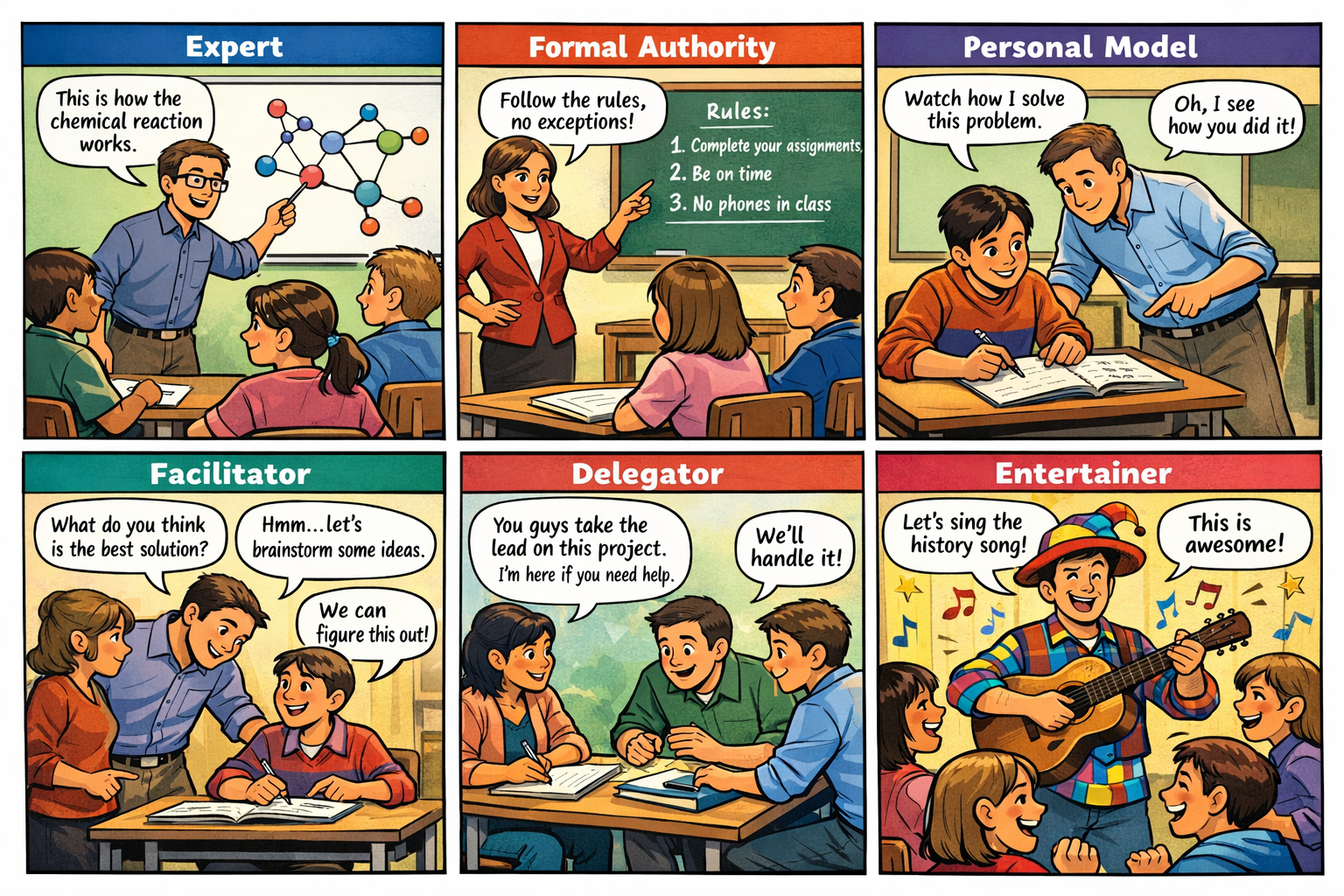
Teaching styles
Expert → Experten
Läraren fokuserar på att förmedla ämneskunskap och visa sin expertis för att utveckla studenternas kompetens.Formal Authority → Formell auktoritet
Läraren betonar regler, standarder och tydliga förväntningar kring vad som är korrekt och acceptabelt.Personal Model → Personlig förebild
Läraren undervisar genom att visa hur man tänker och arbetar, så att studenter kan observera och efterlikna.Facilitator → Handledare (eller Facilitator)
Läraren vägleder genom frågor och stöd så att studenter utvecklar självständigt tänkande och ansvar.Delegator → Delegator (eller Delegerande lärare)
Läraren ger studenter stort ansvar att arbeta självständigt eller i team medan hen fungerar som resurs.Bonus in dancing: Entertainer
Discussion
Discuss
- Do you recognize yourself in any of the teaching styles?
- Do you recognize your teachers in any of the teaching styles?
- Do you think one of the teaching styles is better than the others? Why or why not?

Kursledarprogram WCS 2025-2026